Skip to content

Category: education

Before, During, and After

Accessibility Does Not Stop at the Screen

I have spent more than thirty years working in the digital space. For the last eleven years, I have focused specifically on accessibility. Before that, I worked across nearly every part of the software development lifecycle, from design and development to testing, remediation, and delivery.

Today, I help organizations reduce risk, strengthen governance, and build systems that account for disability and the full spectrum of human variability.

I think about WCAG. I think about keyboard access. I think about cognitive load, predictable navigation, and plain language. I focus on reducing user frustration. Most importantly, I think about how small design decisions either create dignity or cause barriers.

Over time, that mindset has shaped how I evaluate every system I encounter. When systems assume speed, precision, and uniform behavior, they exclude people. When systems account for variability, they reduce harm.

But accessibility does not stop at the screen.

Some systems carry consequences far greater than a broken checkout flow or an inaccessible PDF. Law enforcement is one of them. And too often, that system operates without accounting for how disabled people process, communicate, regulate, and respond under stress.

And for disabled people, that system often operates without accounting for how we process, communicate, regulate, and respond under stress.

When Misinterpretation Becomes Harm

In digital accessibility, we frequently identify mismatches between user needs and system expectations. When a system demands rapid processing speed, perfect recall, direct eye contact, or immediate compliance, disabled users are penalized.

Similarly, law enforcement interactions often rely on narrow assumptions about “normal” behavior. Officers may expect quick answers, steady tone, direct gaze, and immediate response. Yet many disabled people process language more slowly. Many of us avoid eye contact when overwhelmed. Some of us shut down under stress. Others require additional time before responding.

When authority misinterprets those behaviors as defiance or suspicion, situations escalate.

Unlike a website defect, the consequences are not inconvenience. They can include restraint, arrest, injury, or worse.

From a governance perspective, this represents unmanaged risk. From a human perspective, it represents preventable harm.

Why This Feels Personal

For me, this issue is not abstract.

As an AuDHDer, I understand what stress does to processing speed. I know how quickly my nervous system can overload. I have experienced how easily people misread my communication style in low stakes environments. I know what it feels like to search for words while someone expects an immediate response. I know how shutdown can look like refusal to someone who does not understand what is happening internally.

I am also the parent of an autistic adult. That perspective sharpens everything.

When I think about law enforcement interactions, I do not only think about governance frameworks or compliance obligations. I think about my child and his friends navigating a world that often interprets difference as defiance. I think about how sensory overload, delayed processing, flat affect, or literal interpretation could be misread in a moment that demands instant compliance. I think about how quickly a misunderstanding could escalate simply because someone in authority does not recognize disability.

Aliya Rahman’s story brought those fears into sharp focus.

Aliya is a Bangladeshi American software engineer and disability rights advocate who is autistic and has a traumatic brain injury. After federal agents forcibly removed her from her vehicle during an immigration enforcement operation in Minneapolis, she testified publicly about the experience. She described repeatedly informing agents that she was disabled and needed medical care. According to her account, those disclosures did not change how she was treated. She later lost consciousness while in custody and was released without charges.

She later testified before Congress about what happened. In her public testimony, which is available on YouTube, she spoke clearly and directly about the encounter. She described the physical force used against her, the dismissal of her disability, and the lasting impact of the incident. She did not present herself as a statistic. She spoke as a disabled person whose rights and safety were compromised in real time.

Subsequently, Capitol Police arrested her at the State of the Union after she stood silently in the gallery.

Watching her testimony and then seeing that arrest forced me to confront how quickly disability can intersect with power, politics, and enforcement. Standing silently. Processing differently. Responding slowly. These are not crimes. Yet in high stakes environments, they can trigger consequences when systems prioritize control over accommodation.

Her story transformed the issue from policy into proximity. It reminded me that when systems ignore disability, they do not merely inconvenience people. They expose them to physical danger. They dismiss explicit disclosures. They escalate instead of de-escalate.

As both a disabled person and the parent of a disabled adult, I cannot treat that reality as theoretical. It informs how I prepare. It shapes how I advocate. It reinforces why accessibility must extend beyond software and into every system that shapes authority, accountability, and safety.

The Weight of Helplessness

At the same time, watching federal agents use force against marginalized people can leave many of us feeling helpless.

We see large scale enforcement actions unfold. We see power exercised unevenly. We understand how small individual voices can feel in comparison to institutional machinery.

I feel that weight too.

Nevertheless, my work in accessibility has taught me that risk mitigation does not require perfection. Instead, it requires layered safeguards, documentation, and intentional design.

Preparation is not surrender. Preparation is strategy.

Before: Reduce Ambiguity

In digital accessibility, we design proactively. We do not wait for users to encounter barriers before we act.

Applying that same mindset, preparation for law enforcement interactions can include:

  • Learning your legal rights and practicing how to assert them clearly
  • Carrying a disability information card that explains communication needs
  • Identifying emergency contacts and legal resources in advance
  • Role playing scenarios to reduce cognitive load under stress

Admittedly, these steps do not eliminate systemic inequity. But they reduce ambiguity in moments where ambiguity escalates risk. They provide language ready for use. They give supporters a plan instead of panic.

In high stress moments, clarity reduces risk. Clear language under stress protects you. Predefined contacts reduce decision fatigue. A prepared script lowers cognitive load. This is defensive design for real life.

During: Make Accommodation Explicit

When stress rises, executive functioning drops. This physiological response affects everyone, and it can affect neurodivergent people and people with brain injuries more intensely.

If it feels safe to do so, state clearly, “I have a disability and I need you to speak slowly.” Ask for one instruction at a time. Request repetition or written clarification. Repeat instructions back to confirm understanding.

These are reasonable accommodations. Clarity changes outcomes.

Furthermore, clear and direct statements protect legal boundaries. Ask, “Am I free to leave?” Say, “I want a lawyer.” Short sentences carry power.

From a governance standpoint, explicit requests also create documentation. Documentation supports accountability.

After: Document and Recover

Following any high stress interaction, documentation matters.

Record names, badge numbers, timelines, witness information, and medical impacts. Note the exact language used when requesting accommodation. Preserve any supporting evidence.

Just as we rely on audit findings to drive remediation in digital systems, evidence strengthens accountability in physical systems.

Equally important, recovery matters.

Trauma responses are physiological. Shaking, shutdown, confusion, emotional flooding. These reactions signal a nervous system under threat. Therefore, build in care. Seek support. Allow time to regulate.

Accessibility includes psychological safety.

For My Community

Many of you reading this design systems, influence governance, and shape institutional practice.

Consequently, law enforcement interactions are also design questions:

  • What behaviors does the system define as compliant?
  • Whose communication styles does it privilege?
  • Who receives patience?
  • Who receives force?

We must advocate for disability informed training, stronger oversight, and meaningful accountability. At the same time, we can prepare ourselves and our communities.

Holding systemic advocacy and individual preparedness together is not contradictory. It is responsible.

Accessibility Is About Safety

Ultimately, I often describe accessibility as a way to reduce user frustration. That work matters deeply.

Yet accessibility also protects safety and dignity in physical systems.

As a parent of an autistic adult, I can’t treat this issue as theoretical. I think about how my child moves through the world. I think about how quickly difference can be misinterpreted. I think about how a stressful interaction could escalate if authority fails to recognize disability.

Preparation will not dismantle injustice on its own. It will not eliminate power imbalances. However, it can increase clarity. It can strengthen networks. It can replace panic with planning.

I will continue to push for stronger governance and meaningful accountability. Simultaneously, I will prepare the people I love. I will share tools. I will teach clear language. I will document when systems fail.

If we believe accessibility is about dignity, then we must extend that belief beyond the browser.

Accessibility does not stop at the screen. It reaches into every system that shapes how we live, move, and remain safe.

U.S. Capitol Police arrested Aliyah Rahman after she stood and refused to sit down during President Donald Trump's State of the Union address. Rahman was Rep. Ilhan Omar's guest at the event Tuesday. (Photo by Frank Thorp V for NBC News)
Leave a Comment

Choose Your Own Adventure

In the Twin Cities, we are fortunate to have a wonderful organization called Minnestar:

Minnestar exists to build, nurture and engage those interested in technology through meaningful connection. Our goal is to promote connections that help our community learn from each other, build their businesses, and start new entrepreneurial ventures. We aim to foster a thriving and connected tech community for all in Minnesota.

Minnestar’s About Us page

They put on the annual Minnebar unconference. I have been attending since the early days. Earlier in my career, I had issues with self-confidence and imposter syndrome. I never imagined I could be a presenter at Minnebar. It took decades of working in tech with years of running training sessions, teaching web development at the college level, and years of therapy. Then I realized I could, in fact, successfully present a session at Minnebar. I actually submitted my presentation idea while I was attending another event, the CSUN Assistive Technology Conference. The full title of my talk is a mouthful. Choose Your Own Adventure: Pros and Cons of a Formal Autism / ADHD Diagnosis vs Self-Diagnosis. Growing up, I was a huge fan of the Choose Your Own Adventure books.

The stories are formatted so that, after a few pages of reading, the protagonist faces two or three options, each of which leads to further pages and further options, and so on until they arrive at one of the many story endings.

Wikipedia

I submitted my talk idea before the United States Secretary of Health and Human Services, RFK Jr., ramped up his misinformation campaign about autism and suggested creating a national registry to track those of us with ASD. What he and the Trump administration are doing is dangerous and wrong. I modified my talk somewhat in light of these developments. I delivered this talk in person on May 3rd, 2025 and went over these very real choose your own adventure options, walking through the Pros and Cons of:

  • A formal diagnosis through health insurance
  • A formal diagnosis through a private provider (out of pocket)
  • Self-diagnosis via vetted, trustworthy resources

While balancing the privacy implications of each with their potential benefits. I didn’t record my talk but I am sharing the slides. Last year I was invited to deliver a variation of this talk to another company’s Neurodivergent Employee Resource Group. I would be happy to speak to this or related topics at other organizations. Feel free to reach out to me at info@sharynmorrow.com.

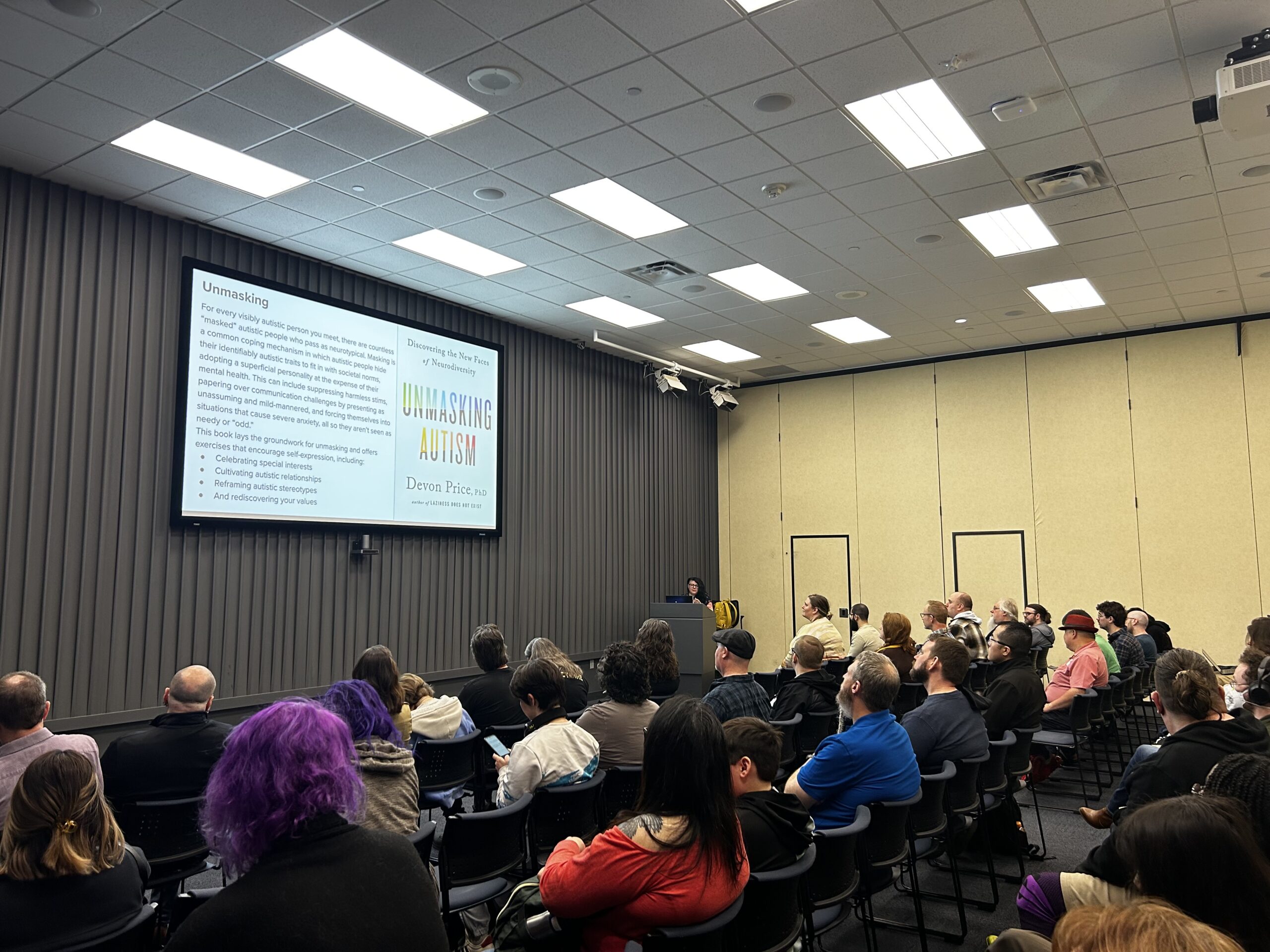
Speaker Sharyn Morrow standing behind a tall podium while presenting to a full room of attendees.
1 Comment

Against Technoableism

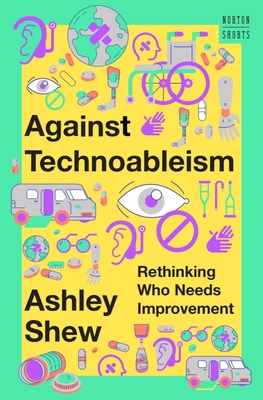
2023 has been a great year for books in the disability space. Previously, I posted about Sounds Like Misophonia by Dr. Jane Gregory. Most recently, my copy of Against Technoableism arrived.

When bioethicist and professor Ashley Shew became a self-described “hard-of-hearing chemobrained amputee with Crohn’s disease and tinnitus,” there was no returning to “normal.” Suddenly well-meaning people called her an “inspiration” while grocery shopping or viewed her as a needy recipient of technological wizardry. Most disabled people don’t want what the abled assume they want—nor are they generally asked. Almost everyone will experience disability at some point in their lives, yet the abled persistently frame disability as an individual’s problem rather than a social one.

The MIT Press Bookstore

Technology needs to do more for people with disabilities. Ashley Shew argues that it’s not the individuals who need “fixing,” it’s their environment. The author is participating in an upcoming free talk. The ITS Technoableism seminar series presents: Ashley Shew on Monday, January 15th, 2024. She was also a guest on The Disability Rights Florida podcast last month.

Against Technoableism: Rethinking Who Needs Improvement (A Norton Short)

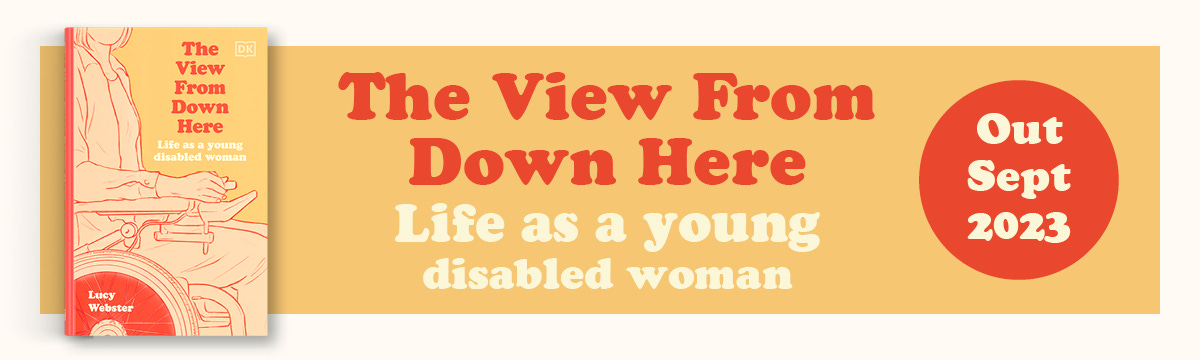
Prior to that, the most recent addition to my non-fiction book stack was The View From Down Here: Life as a Young Disabled Woman by journalist Lucy Webster. In her own words, it is “a memoir exploring what it’s like to live at the intersection of ableism and sexism, how these forces have shaped me, and how society often fails to see disabled women as women at all.” Get the book and sign up for her newsletter!

The View From Down Here: Life as a Young Disabled Woman By Lucy Webster book cover Out Sept 2023

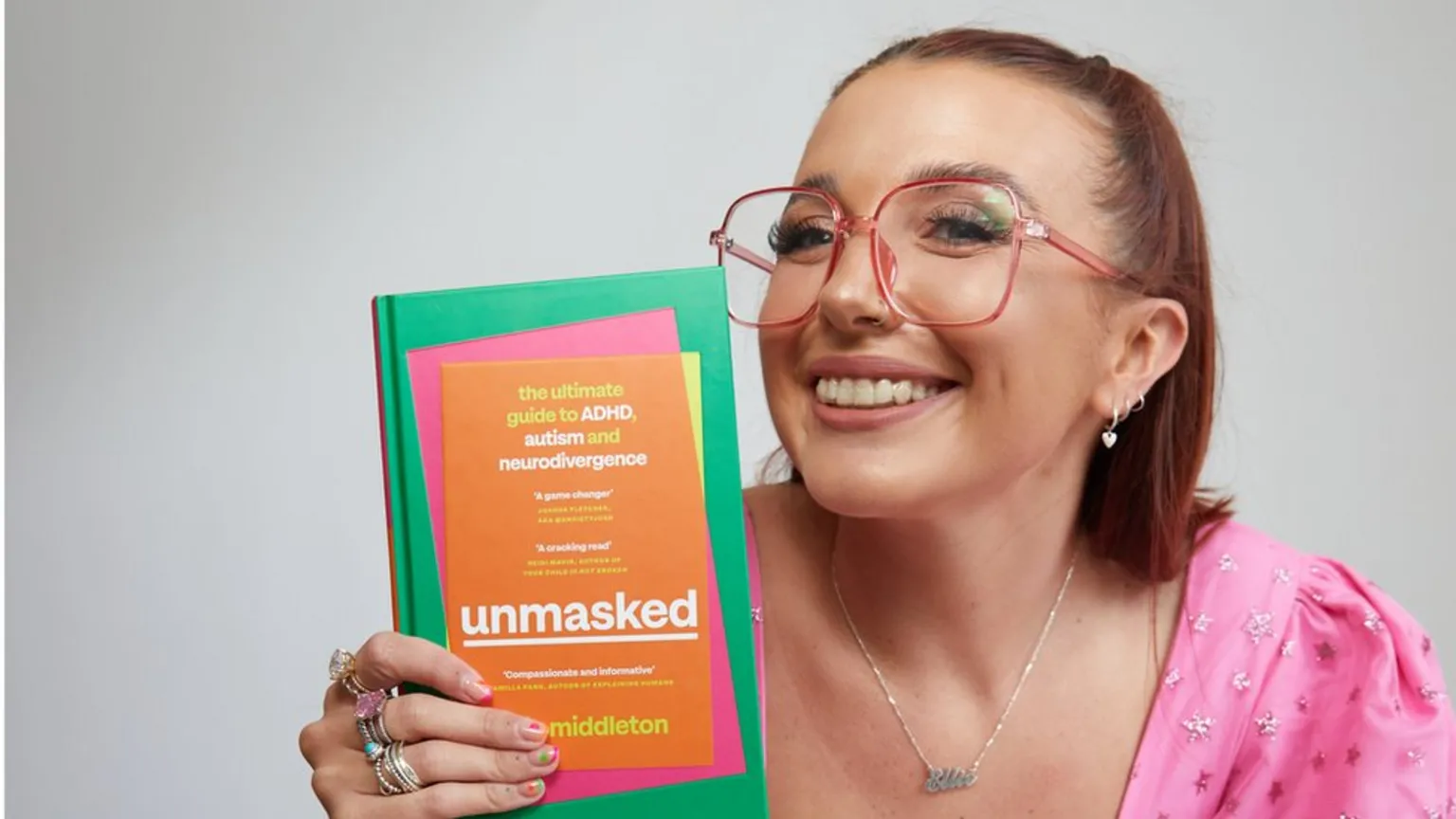
Skipping back to October, a couple of significant things occurred. After years of wondering, I was formally diagnosed with autism and ADHD. On the same day I had my final session with my fantastic clinician, a book I pre-ordered arrived. And, in the most ADHD move ever, another copy of the same book showed up the next day. Apparently, I’d pre-ordered it two days in a row without realizing it. That book was Unmasked: The Ultimate Guide to ADHD, Autism and Neurodivergence by Ellie Middleton. Thankfully, I was able to give the second copy to a friend who has been pondering her own neurodivergence.

“Learning the way my brain works has changed everything for me,” she says, and describes herself as almost being a poster girl for what can happen when you get the answers you need.

Ellie Middleton BBC Access All
Author Ellie Middleton grinning while holding a copy of her book Unmasked: the ultimate guide to ADHS, autism, and neurodivergence
Leave a Comment

An Invisible Disability

June is National Migraine and Headache Awareness Month.

I have a personal connection to this sort of chronic pain. I’ve had migraines since I was a teenager. Thankfully, those tapered off in my 30s for the most part. But last November I started having a headache that never stopped. After two visits with my primary care doctor, I was referred to neurology in December. I booked the first available appointment with a headache specialist. That appointment was May 31st. It has been an awfully long time to wait but I want to gush about how great specialists are. The woman who saw me really knows her stuff. I finally have a treatment plan in place. It’s not going to be easy but I feel hopeful for the first time in a while. She confirmed my suspicions. My occipital nerve is inflamed. Once aggravated it can be difficult to calm down.

  • I’ve started taking amitriptyline daily before bed, and will slowly increase the dosage on a schedule.
  • June 1st I received an occipital nerve block injection in the back of my skull and trigger point injections in my neck and shoulders. A cocktail of pain killers and prednisone.

The specialist made referrals for:

  • A sleep study (consultation is this week)
  • A TMJ specialist (need to start wearing my night guard again)
  • Physical therapy (first appointment is coming up)

I like posting about these topics to raise awareness, and it gets people talking and sharing their experiences. But I want to point out the tremendous amount of privilege I have. I’ve got great health insurance through my employer, a flexible work schedule, and a reliable car. And it still took that long to get a treatment plan in place. It’s so much harder for folks who don’t have the advantages I’ve got.

June is National Migraine & Headache Awareness Month
1 Comment

Progress Not Perfection

Last year, I started working for my current employer just weeks before Global Accessibility Awareness Day 2022. I wasn’t involved much in the planning of that event. But for GAAD 2023? I was all in. So much so, I was even flown out to HQ in New Jersey for my first business trip since before the pandemic. It was wonderful to meet many of my colleagues for the first time after working with them for over a year.

In my role of Principal Accessibility Engineer, I have been able to grow our program this past year. Beyond our Product and UX teams. Colleagues across the company have had more accessibility questions both general and specific. In addition to the a11y course we deliver to devs, I created a general accessibility overview course for all onboarding employees. I hope to expand that offering to include all employees eventually.

Likewise, for GAAD this year we wanted to include everyone. We pulled panelists from Legal, DEI, Technical Writing, and Product. To discuss how far the company has come on its accessibility journey, and where we’d like to grow. Hence the Progress Not Perfection theme. We also partnered with the mission-driven Knowbility for our keynote which covered everything from industry trends to creating accessible content. And our team in India held their own event complete with demonstrations, activities, prizes, and lunch. Feels great to have another successful GAAD outreach event in the books!

Leave a Comment

World Usability Day 2022

The annual global event, World Usability Day, will be observed on Thursday, November 10th, 2022. I’m slated to deliver accessibility training to international colleagues that day, so I’ll be missing my local UXPA MN event but I’m a big fan. World Usability Day is a single day of events occurring around the world that brings together communities of professional, industrial, educational, citizen, and government groups for a common objective: to ensure that the services and products important to life are easier to access and simpler to use. The theme for this year’s World Usability Day is “Our Health.”

In our theme “Our Health” we look to explore systems that provide healthcare in all its many forms such as virtual/telehealth, electronic health records, healthcare products and all digital health related solutions. This theme will help us explore timely and important issues such as continuity of care, access to treatment, telemedicine, systems for mental health, exercise, nutrition and many more. In addition, Our Health includes health problems related to environmental issues such as air and water pollution impact on health.

World Usability Day

Participate in one of the global events, if you are able to. And be sure to sign the Usable Tech for Good petition.

If the UN recognizes usability as a core digital technology value, this will create an awareness of HCI/UX at the policy making level, increase the public engagement with the investment in user experience, potentially lead to a global impact, and let usability do its part for the UN’s Sustainable Development Goals. 

WorldUsability Initiative
World Usability Day logo with the earth surrounded by a green circle and the text Make Things Easier Day
Leave a Comment